Sunday, August 9, 2015

Thursday continues--Hobby Shops and Trash Picking

I really thought that Bob was kidding when he was researching hobby shops in Naples before we left.  I mean, really?  We go all that way, with all those things to see, and you want to check out a hobby store?

But Dane had gotten (or been given) a model rocket, and they needed materials to build it (hobby knife, sandpaper, plastic glue, paint).  Bob looked at it and said "you know where you can get all this?  A hobby shop."

So after the necropolis we headed back to narrow roads crazy traffic anything goes downtown Naples.  I crawled under the back seat and drooled on  myself just a little.  But sure enough--Bob spotted the shop.

And in the world of plastic models there is no language barrier (helps that the shop owner spoke English until Bob would say something like "1/72nd scale after market parts for . . . . . "  at that point, even though I do speak English, it just sort of degenerates into random sounds for me.  But model speak is universal, and he bought a few items for himself, and the stuff that Dane needed for the rocket.

 
Then it was time to indulge in Amanda's hobby: the search for the demijohn.  Farmers have to give a certain amount of their grape harvest for the "community wine"--apparently you just take bottles and go get it. (As a connoisseur of cheap wine, I would have liked to try some of this.  But Amanda and Robert don't drink so didn't have it around.  Besides, in the heat it would have laid me out.  Note to self: go back in the winter to drink wine.  But I digress).   Cheap wine comes in rather nice glass demijohns, and Amanda has been collecting them. 

 
The trick is not to go out and buy them--that would be too easy, and where's the challenge?  The idea is to make it a quest--to go on the search.  When people are done drinking the wine, they just throw the bottles away.  And the easiest way to throw them away is to toss them on the side of the road ("Keep Naples Beautiful" is a fairly recent idea that hasn't taken hold yet).  So her idea of fun is to just drive around the back roads out to the farming areas and scope out the trash in the ditches to see if she can spot a treasured bottle. Then she jumps out and grabs it while keeping an eye out for the farmer's dog.
 
 Now these are narrow rutted dirt roads only about as wide as the car--but I was fine with that.  I just don't like the idea of scraping buildings or other cars--getting stuck in the mud is something I can deal with (fortunately there was no getting stuck today although at one point we had to do a 14-point turn when the road ceased to exist)
 
One thing we had noticed almost immediately in Naples was that anywhere there was a bit of spare land, there was a crop.  Like the areas around overpasses.  Sides of highways.  The volcanic soil is rich and fertile.  As we got away from roads, we saw orchards of plums and pomegranates heavy with fruit, fields of fennel and thyme, tomatoes, and peppers.  Truly beautiful.  Did I take a single picture?  Nope--I was busy keeping an eye on the roadside trash.  We (meaning Amanda--we don't have the eye yet) did score one, so our day was a success.  It was clear, and only medium sized, but it still had its (plastic faux) wicker basket. (At one point she did spot a large green one, but, alas, broken)


Between the awe of the necropolis, the craziness of finding the hobby shop, and the fun of trash-viewing we decided that the day was full enough and wandered back home.
 
Friday:  Monte Cassino

Thursday in Naples:Necropolis

We got off to a late start on Thursday.  Dane headed out to the coast with the dive group, and we sat around and chatted.  Part of me was antsy, ready to go see something, but after two long hot days it was also nice to take a break, talk family stuff, and knit (remember the knitting?)

We eventually got ourselves off the couch (and away from the air conditioning  :-(  ) and went to a cemetery, the Cimitero de Santa Maria del Pianto.

This is a more recent cemetery--according to Wikipedia, it's been in active use since 1865.  Also according to Wikipedia, it covers about 7 acres--but it seemed like more. 

When we first drove in, it seemed organized enough--the roads were fairly wide and lined with the mausoleums.  But this first impression was quickly erased--as soon as you walk past that first neat row, all the tombs and mausoleums are just crammed together higgledy-piggledy.  Cheek by jowl.  Just wherever there was space to put another one, without worrying about rows and definitely not about any similarity in style.


We first walked through the "low rent" district, where many graves were set into a tuffa wall.


As you can see, many of the formerly sealed fronts had cracks (or had completely fallen away), with plants taking advantage of the rich volcanic (and, uh, "organic") soil.


 One gentleman has even been transformed into a tree.  It's a pleasant thought.  The air was sweet with wild mint.

I was at first confused by what seemed to be a series of low greenhouses.  Closer inspection showed that they were covering underground mausoleums.


Apparently there are stairs through some of the other tombs to go visit below as these had obviously been carefully tended.

I'm used to modern American cemeteries--neatly laid out rows, small nuclear families--perhaps parents and children together, but not much more.  Here, generations of families lie together.  When you peer between the bars of the tombs, you can look down the stairs to the underground older graves.


And it's still in the middle of the city.


And yet, in the middle of a weekday, oddly deserted.  The three of us were the only living beings in this necropolis.  But on the graves were fresh (if artificial) flowers.  All was slightly overgrown, but not to ruin.   This is still a cemetery in use, with signs that loved ones are still interred here.

 
(I love the ubiquitous plastic chairs and the jugs and other detritus.  This is not a museum, but a place for families) 


Moving into the "higher rent" district, the tombs become larger and more imposing.

 
Those stone figures are life-sized.


Bob is slightly larger than life-sized, but good for scale.  Those large modern-looking buildings to the right are also mausoleums.


One tries to grasp that this is not a preserved historical site.  It seems so old--but by European standards it isn't.  Despite the gentleman's ruff, this necropolis is only 150 years old (although plague victims from the 1600's are sealed in a cave below parts of it)
 
But it's time for us to leave the hush of the city of the dead and go back to the crazy city of the living.  Bob has a hobby shop to find.


Saturday, August 8, 2015

Wednesday in Italy, continued

Although we had seen and been amazed by the ossuary, Amanda was still determined to find the catacombs.  We consulted the browser on her phone, and the GPS (which didn't seem to agree with each other) and I crawled out from under the backseat where I had been hiding as she drove through the town and saw a banner that said "Underground Naples" (or something like that--it was in Italian for some reason).  We found a parking garage (not quite like we have in the states but it would do) and walked over.

It was the San Lorenzo Maggiore church/convent, and underground were the ruins of a Roman marketplace.  Narrow roads (some things never change) and a variety of storefronts.

 
The bakers, with a domed oven not unlike you still find in the pizza shops


The sign for the dye works.  I was amused to find it translated into English as "Dry Cleaners."  All the modern conveniences!


And the dye works themselves

 
A random room, showing some of the stucco which would have once covered the walls.
 
 
We love roaming around ruins, and would have been more impressed if we hadn't still been reeling from the ossuary, but it was cool and pleasant down here under the city.
 
Amanda was *still* determined to find the catacombs.  Bob asked one of the guides where they might be, and he gave us directions to a church--where there were no catacombs.  So then Bob saw a postal delivery woman, and asked her, and got directions to another place that was a museum, but not with catacombs.  We stopped into a cafĂ© where Amanda had fruit and Bob and I indulged in our first Italian pastry.  Crisp puff pastry with chocolate filling.  I'd like to say that we sipped an espresso alongside, but it was so hot that we opted for water with lemon instead.
 
Amanda's phone was started to run low by now, so she called Robert to do a search on the computer for the catacombs and text the address to her.  I then took a picture of the text so we would have the address to put into the GPS when we got back to the car.  Technology!


We walked back to the parking "garage" where the valet jiggled her car out (hers is the white one) and went off in search of San Gennaro.


We went around a loop a couple of times and finally realized that we had driven right past it on the way into town that morning.  That's OK--if we hadn't gotten lost, we wouldn't have found the ossuary at Fontanelle.
 
And finally we were going to a catacomb--down ramps and steps that led through apartment buildings (Naples is very much built on the historic sites) we went into the cool underground.  Gennaro is famous for the longevity of its use,with frescoes spanning from the 2nd to the 10th century, showing the changes in Christian art.  They are extensive (possibly because it is very easy to carve into the tuffa) and cover about 5 square kilometers (about 2 square miles)


Despite the fact that we were in the catacombs, and you could see the open tombs, there were no remains.  Sometime around the 18th century they were removed--some to go to churches, but most went to . . . Fontanelle!

Amanda said she would have preferred to have the story in chronological order, but I was rather happy that we had found the ossuary first (and been caught off-guard by it) and then learned the story about where some of them had begun their afterlife.

Even after visiting the other two sites, it was the ossuary at Fontanelle that continued to haunt us.  That evening, Bob looked down at his crocs and said "I think I have dead people dust on my shoes."

If I recall correctly, this is the evening that I spent socializing with the family by sleeping on the couch for two hours.  Amanda took a picture but was kind enough not to post it. 

Thursday--Cemetary and trash-picking.  Stay tuned!


Intermission

Had a little delay in my blog writing.  We had a heck of a storm last night--including one strike where the lightening and the crack of thunder happened almost simultaneously.  We yelped and the lights went out.  Then we noticed that not everything was out--some of the other rooms had light.  We checked the circuit breaker and a lot of the breakers were popped.  Turned them back on and all was well.

Then I was going to check my email this morning and no internet.  Looked at the modem and it was dead--made note to call Comcast. (When Bob picked up the modem later, we could hear parts of it rattling around inside.  It really got fried).  When I walked outside, I was puzzled to see a fresh split piece of wood lying on the ground.


There were several of these scattered around.  I looked where they were denser, and then spotted the tree that got hit.


It's a little uncomfortably close to the house.


Here's the hole where the lightening exited--with the smoke mark on the tree and the little hollow of charcoal.

So we spent today going to town for a new modem and the requisite hour or two on the phone to get it to work.  Now I can go back to writing about Italy.


Friday, August 7, 2015

We See Dead People!

So you've been warned.

Amanda saved me from an attack of senility.  I *knew* I had gotten a picture of the first bonding moment of Bob and Zeke.  Zeke, at two years old, is not one of those toddlers who wants to be hugged by everybody.  You approach him, he backs off.  You push it, he cries.  But at Pompeii, Bob wanted to take a break, sit, and sketch for a bit.  Zeke thought that looked pretty cool, so Bob gave him a piece of paper and a pencil and they both sketched together.


But I couldn't find this picture anywhere.  Turns out that Amanda had taken it with her phone, and she sent it to me, and I feel I'm in possession of my brain cells for a little while longer.

Wednesday we went in search of the dead.  Amanda knew there was an Underground Naples she hadn't seen (assumed to be catacombs) and there was a cemetery in town that she had heard was interesting but hadn't seen yet.  So off we went, Amanda and Bob and myself.  Dane was off scuba diving, and Robert isn't into dead things and opted to stay home in the air conditioning with Zeke.

It's amazing how much Naples resembles Oaxaca, Mexico.  Pale stucco buildings, iron balconies, laundry hanging out,  small altars set into niches in the walls. very narrow roads, crazy traffic.

Very. Narrow. Roads.   And the traffic rules in Naples are really just sort of suggestions, mostly ignored.  Amanda would just head down narrow roads that wouldn't fit a donkey cart, steering wheel in one hand, GPS in the other.  You don't wait for a gap in traffic--you just nose into it, and if you cut off the other lane while you're doing it, well, that's just what happens.  She said there is no road rage there, no sense of "wait your turn" or "get out of my way."  Bob found it very interesting.  I just sat in the back seat and tried not to whimper too loudly.  Especially when two cars were going past each other in a street not quite wide enough for one.  Both drivers pop down their side-view mirrors.  Amanda asks Bob how much clearance she has on his side.  "Uh--about two inches."  Great!  She narrows that down to one inch, and the two cars jiggle past each other.  We did not experience the "Naples kiss" where the two cars gently scrape each other--my whimpering may have gotten a little louder.


(This street is actually wider, less busy, and much straighter than most, but I was too busy burrowing under the seat cushions to take more pictures.)

It turns out that addresses in Italy are mostly useless--you try to get GPS coordinates.  Even then the GPS often says "you have arrived at your destination" and it's nothing like you were searching for.  And there are rarely signs for anything.  So we went up narrower and more winding streets until we came to a quartz quarry.  Hmm.  A couple of blocks earlier I had briefly opened my eyes and had seen a small sign that read "Cimetiro della Fontanella" so we went back to see if it had any directions.  No directions--this was it.  Though it didn't really look like the entrance to a cemetery, we went in anyway.  Here's where we parked, with cars going both ways.  You can see it doesn't look much like a cemetery would be there.


We walked in, and there were a couple of men who said we could come in, and at first all we saw was a large cave cut into the hillside (remember, we were next to a quartz quarry--and thought we were in another one.)  It looked rather empty, until we looked down and behind the low white fences that ran along the walls.

We had found an ossuary.  When you think of ossuaries, you imagine going to a church or at least a museum, and going down below the buildings.  You don't expect to step off a busy street, and there they are, in the sunlight.


We think the wimple and the rosary on the second skull shows that she was a nun.

We walked deeper into the cave.  The walls were lined with reliquaries holding skulls, with thousands of other skulls and bones piled behind them.

 
It was eerie walking deeper into the cave, with the sound of dripping water and the incongruous singing of birds outside.
 

The rather rough looking blocks on the side of this arch are actually the ends of thousands of leg bones laid crosswise.

 
Many of them had altars and offerings.  And this is where we got confused.  You think of ossuaries being old, old, old.  And yet on the altars were color photographs, tickets, plastic dolls.


Later, we looked up the history.  Back in the 1500's when cemeteries were getting full, older bones were removed and dumped in the cave.  It later became a dumping ground for plague victims, and those too poor to afford burial space.  It was used like this up to 1836.  In 1876 a priest began the undertaking of cleaning up and cataloging the remains.  Around this time the remains were also "adopted" by the cult of abandoned souls, who gave them the respect they did not have in their lives.  Apparently this adoption also included making up lives for them, hence the modern offerings.


I am not certain of the significance of this statue of a headless angel.
 
 
I did feel a little uncomfortable, trying to decide if I was the sort of person who would go around taking pictures of dead people (after all, just the day before I had realized that I could not take pictures of the plaster body casts).  But obviously I did.  Perhaps it was because of the sense that these remains were long past any bodily cares, and they were arranged and treated with respect.


It was strange, and eerie, and oddly peaceful and very disturbing.  I'll carry this with me for a long time.


Thursday, August 6, 2015

Monday: Pompeii!!

A few more observations on travel before heading off to Pompeii:

1)  Bless whoever it was that invented wheelie bags.  Like many people now, we travel mostly with carry-on baggage.  But airports are so huge, and you always get off Plane A at the opposite end of the terminal from where you get on Plane B, and you have to lug your bags along.  Wheelie bags are a wonderful invention.

2)  We don't travel much.  I remember the days when you'd go up to a counter, and a person with a professional looking smile would check your documents and then hand you a professional looking boarding pass.  For this trip, I just printed them out at home.  Somehow it just doesn't seem as official--I kept expecting it to be handed back to me with "are you kidding?  Go get a real one."

But with wheelie bags and home-printed documents we got to Naples.  After our zombie-like wanderings of Sunday, we crashed like two bricks, and woke up ready to go on Monday.   First things first:  we *had* to see Pompeii.

Got an education just driving there.  Apparently, ladies of, um, "negotiable affection" advertise their status by sitting on plastic buckets (right along the side of the road).  If they're really classy, they'll be sitting in a chair, with the plastic bucket beside them.  Note to self:  be careful when and where I ever use a bucket for a seat.

Somehow, Pompeii and Mt. Vesuvius seem like a place out of myth and legend--rather like Middle Earth or Narnia or Hogwarts.  I wasn't expecting to just be riding down the highway and there's Mt. Vesuvius, just sitting there like an ordinary mountain.  And Pompeii should be a mystical land--but Dane declined to go with us, shrugging with an "I've already been there four times."  Pompeii the AD 79 Ruins are just part of the town--there is still just a regular town there (sort of like there's a real city around the French Quarter in New Orleans).

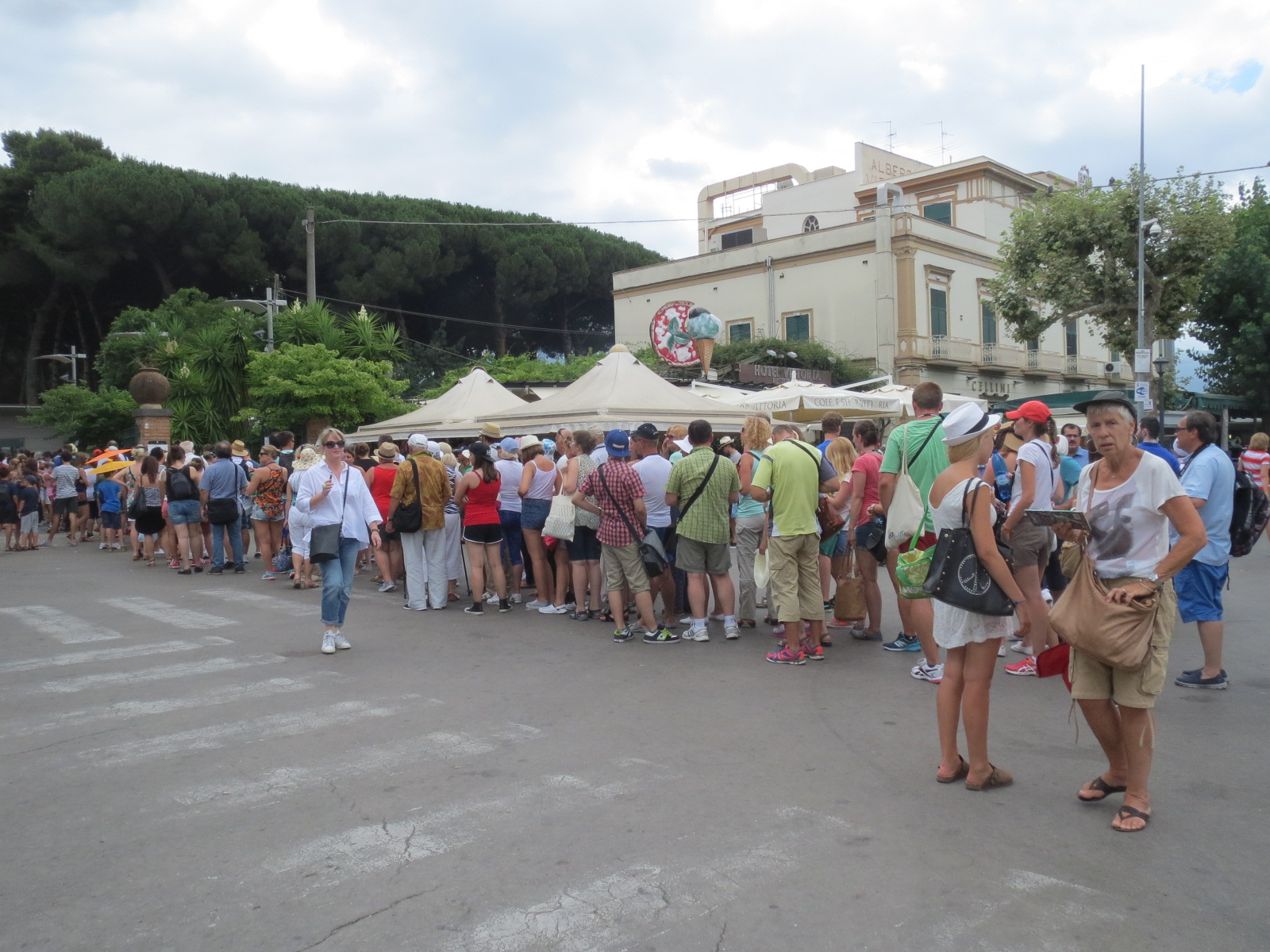
I was expecting it to be touristy--and it was.  Long lines to get in, endless rows of stalls selling plastic souvenirs, men in centurion costumes to be posed with.   I did have much angst wondering whether to get a souvenir that *really* said "Pompeii--happy to see you" but either good taste finally won out--or I was just too embarrassed to pick one up (and Bob wouldn't do it for me).  Picture here is small on purpose--click to enlarge at your own risk.


But none of this could distract from the fact that if you look the other direction from all this you would be seeing Roman walls that were built over 2,000 years ago.  And then to realize they were preserved by a catastrophic destruction.I didn't realize how huge Pompeii is.(I think that tiny arm in the picture belongs to our great-nephew Zeke)  In it's day, it was about 170 acres.  A lot of the ruins have been since destroyed, but it's still impossible to see it all in one day.  We tried.  We wandered around for 5 hours. 
But there's a limit to how much your brain can absorb, especially when it's in the high 90's.  Fortunately, they had water stations where you could refill your bottles.

In the hours of walking, we tried to get a feel of how this area would have been when it was alive.  It is a normal tendency to think of Pompeii strictly as that one day in August AD 79 when the volcano blew and covered everything in ash and lava.  But it had been a thriving town for 160 years.  There were baths, and gymnasiums, and the ampitheatre.  Homes and families and stores.  Art and beauty. Frescoes and mosaic floors. With Mt. Vesuvius always visible, but just another mountain.

Yes, the bodies were there, made by pouring plaster into the molds made by the ash covering the people who died.  I found that I couldn't take pictures.  Two thousand years, and it was still too soon.  I think it was the immediacy of it--they were captured in a moment of terror and agony.  I wanted their lives, not their deaths.


And they were also a practical people.  The sidewalks were raised on either side of the street so that during rainy weather you could still keep dry (and not risk stepping in what all those cart horses left behind).  At the street corners there were steps to get across--with gaps in between so that the carts could drive over them.  There must have been many carts over the years--stone is hard, but the streets had grooves worn in them by the wheels.

 
In a small way, it's still a living town.  To us, it is a snapshot of a moment of history, a glimpse of a long-past civilization.  To a street dog on a hot day, it's a cool place to take a nap.


And Rome too had their "ladies of negotiable affections."  The advertising on their house was not as subtle as sitting on a bucket.


The walls of the house were decorated with frescoes advertising their services


We could only go downstairs, where the less expensive girls would ply their trade.  I really hope they had a mat of some sort!


After many hours of wandering, we finally had to admit that we had lost our battle with the heat.  Fortunately, Italy is famous for its lemons (some as large as a cantaloupe!)   Some glasses of lemonade were most welcome.


Tuesday:  We See Dead People!