Wednesday, November 9, 2011

Sunday in Teotitlan del Valle

Started the day with another long stroll--in search of breakfast.  Finally found a hotel dining room that was opening (and not limited to guests).  But the dining room was worth the wait--it had a flower-bedecked altar, high ceilings, old paintings of saints on the walls.  We had cups of the incomparable Mexican chocolate, with bread to dip into it, yogurt, a lovely platter of papaya, watermelon, cantaloupe, and pineapple, with crunchy churros to finish.  While we were waiting for our repast, we were spotted as tourists and serenaded by a guitarist and a young boy who sang with great feeling and dramatic gestures.

Then we walked to go--meet a homey!  Small world--a woman that we both knew at Florida State retired a few years ago to Oaxaca.  She still keeps a room there, but Oaxaca got too big and crowded and she moved to the next village over, Teotitlan del Valle.  She was headed back home Sunday morning, so we joined her for the taxi ride there.  She lives with two widowed ladies there and is helping them to set up a bread and breakfast (the smaller villages are still very traditional and it's the men who have the jobs--it's difficult for a woman to make it on her own).   Although we've only been away from home for a few days, I was glad that there were two dogs and a lovely tortoiseshell cat to greet us and let me get in some critter-cuddling.  Roberta has an upper floor apartment with a large patio overlooking the mountains and a courtyard with pomegranate trees (and hummingbirds).  We drank more chocolate (made the traditional Mexican way, with water instead of milk--quite good when the chocolate is excellent) and had sweet bread.  After our snack, we walked to go visit the town.

Teotitlan del Valle is known as "the village of the weavers" (villages tend to have specialties--some villages have potters, some are agricultural) so I was in heaven.  But there is the similar feeling here as that in the market in Oaxaca, that I can only call "desperate abundance."  There are beautiful rugs for sale everywhere--and all rather the same.  Who is to buy them all?

We walked to the church (where a friend of Roberta's admired Bob's beard--the natives seem to be able to grow mustaches but not beards).  Although we were allowed to take pictures inside, we didn't.  The paintings, statues, incense, flowers, saints, and Christ crucified are so beautiful, so big, so overwhelming that to try to reduce it to a few snapshots would diminish the memory.

Roberta then took us to visit the woman's cooperative.  This is an anomaly in rural Mexico--women are expected to remain in the home, not be activists.  But through their work with the community has earned them respect, and a voice in the village meetings.   Their work is at the grassroots level, and it's having an effect.  One of their earlier efforts was to help clean up the village--they got large recycled paint cans, cleaned and painted them (with sayings such as "water is life" and "don't pollute", and put them around the town so people had a place to put their trash rather than throw it in the street.  At first emptying the cans was done by a volunteer but the village eventually set up a trash pickup.   The women also raised contributions and did the work to plant some 400 trees to replace those cut for firewood and reduce water runoff.

The project that interested us the most was their modification of a traditional Zapotec cooking tradition: a comal (round, slightly curved griddle) over an open flame.  This has a few drawbacks--it's smoky, a bit dangerous if children are running around, and uses quite a bit of wood.  The cooperative designed a modified stove--by simply building a clay wall around most of the cooking area and adding a vent to the outside, they removed the smoke, and greatly reduced the amount of wood needed to cook--all without taking away the tradition.

I realize this post is growing a little pedantic--but I was really impressed with the changes these women are making.

So . . time to go back.  No taxis are hanging around Teotitlan del Valle on a Sunday afternoon, so we waited on the street corner for the bus.  Normally they would run to Oaxaca, but Sunday is the market day in the next village over (which I won't even try to spell) so they were running there instead.  So into the next town, down the block to the next bus station (grabbing some fresh bread and fruit at a stand, just in case the munchies hit), and on the bus back to Oaxaca.  A quiet stroll, a quesadilla at a stand in the park (you watch her make the tortilla, then fill it with cheese and herbs as it cooks on the comal), and back to the room to repack--the tour starts tomorrow!

Tuesday, November 8, 2011

Saturday Afternoon in Oaxaca

After a short siesta (construction still going on at the hotel) we went to find the new Museo Textil (Textile Museum).  What a beautiful find!  Again--the best of old and new.  Old colonial building, but with modern displays (acrylic bars and monofilament so that many of the articles floated in the air).  High arched ceilings.  Some of the pieces were backlit to show off the elaborate weave structures.  Sadly, one of the points of the displays was to show how the textile arts in the Oaxaca area have degenerated over the last couple of hundred years.  People are just busier, and these things take time.  This was carried to the sad extreme that I later saw in some of the vendor's booths at the zocolo (city square):  Native women with plastic knitting frames, turning out acrylic scarves for the tourists.  Heartbreaking for a textilian like myself--but these women have to make a living, and the average tourist will be happy with something made by a "real live native" without caring that it has nothing to do with generations of tradition.  Sigh.

No photography was allowed at the museum, but they do have a web page:  http://www.museotextildeoaxaca.org.mx/

And, of course, during our walk, we admired the architecture:


And we spend some time spotting two cultural icons:  Donaji and Catrina.

Donaji.  There are several variations on the story of Donaji--it dates back to the pre-conquest times and is sort of a Romeo and Juliet theme.  The Zapotecs and Mixtecs were at war with each other; a Zapotec princess (Donaji) and a Mixtec prince were in love with each other.  At one point, Donaji had to betray her Mixtec love in order to save her people, and was killed and decapitated.  Her body was found, but not her head.  Time passed.  A young shepherd saw a lovely lily growing in a field--he went to dig it up, and found the still-beautiful head of the princess Donaji, with the lily growing out of her ear.

Donaji is now on the coat of arms for the city of Oaxaca, and her image ( a tilted head with a lily growing out of her ear) may be found on many government buildings (and on the hoods of the garbage trucks).  She is a sign of Zapotec pride.  Some things just get a little lost in the cultural translation--a decaptiated head with a flower in her ear?


Catrina:  Many of the Day of the Dead figures show various skeletons doing everyday tasks, or in everyday poses.  The most famous of these is Catrina, an upper class lady with a fancy hat.  Depictions of her are everywhere, and she was a popular costume of girls going to school dressed up on Halloween morning.  It's really quite amusing to see these lovely, well dressed skeletons.   While we didn't get to go see the show, the "drag queen Catrina" poster looked like it would be interesting.


And a few more skeletons, just for fun (I ain't never seen a skeleton with bosoms before)


Saturday Morning in Oaxaca

Each town in and around Oaxaca has its own market day--the BIG market in Oaxaca is on Saturday.  We decided to get up and hit it early, before it got *too* crowded (one writer described the Saturday market as "Maximum Occupancy: One Hundred Gazillion People.")  We actually got out a little too early--Oaxaca is justifiably famous for it's food, but it's hard to find anything open in the morning.  We finally stopped at a coffee shop for a pastry and coffee.  Then down the several blocks to the market.
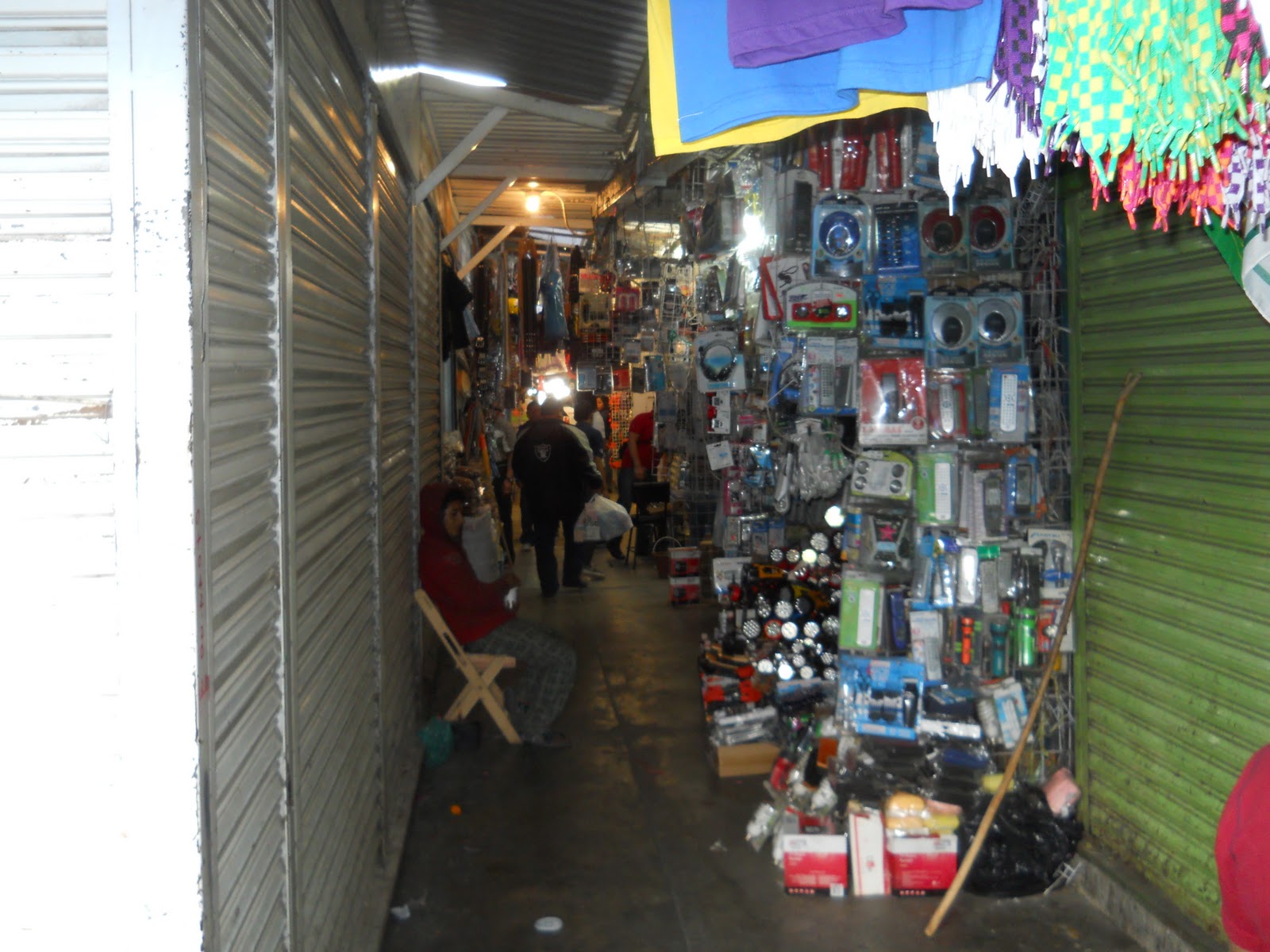
In today's venacular--OMG!!! Words like labyrinth, maze, or rabbit warren can only suggest the absolute claustrobia of this place. It's a fire marshall's nightmare--aisles only maybe four feet wide (sometimes less), packed with people shopping, pushing handtrucks, selling their wares (you have to pay for a booth, but you can walk around selling your stuff for free). If you're native, you just push through. If you're a gringo, you find yourself squeezing sideways and saying "perdonme" a lot. (Although a couple of girls rounded a corner and found themselves eyeball-to-naval with Bob and screamed) It's alive. And filled with that incongruity that defines Mexico. You don't step back in time--but you do somehow step a little sideways. Old and new blend together. Dozens of booths of clothes (designer jeans--even the mannequins in Mexico have impressive curvy backsides) and various flea market gew gaws. Cell phones. Tools. Traditional pottery. Chocolate being ground. We go by the fruit stalls and supplement our breakfast with tiny monkey bananas (sweet, firm, tasting of banana and apple), mandarin oranges, and drippy juicy pineapple. Zapotec (Native tribe) women
 selling herbs and copol incense.  We get paper mache skeletons, chocolate, mole paste (a chili/nut/chocolate paste for sauces), ceramic skulls, bread.  Do a double take at a large goat costume.

What overwhelms us most is the abundance of everything.  It is a market, and people are there to sell, but are there enough buyers for it all?  Think in terms of thousands--thousands of bulbs of garlic, thousands of peppers, thousands of loaves of bread (jeans and cell phones will keep, but ripe fruit doesn't), thousands of flowers.  The other odd thing didn't occur to me until the next day--the market didn't stink.  You'd think that many people and stalls and food (including unrefrigerated meat and chickens and fish) would get a bit ripe smelling--but it just smelled of incense and chocolate and the seaside and cooking meat--no smell of rot.  I don't know if it's the dry desert air, or the natural frugality of people who don't let food go bad, but it was odd (I'm used to flea markets that always smell like they need a good bath.)  We slowly made our way up the street--crowded, because vendors who can't fit into the market set up stalls for blocks all around the market.

After that morning, we were ready for some quiet time, so it was back to the room for some Fanta soda (made with sugar, not corn syrup), bread (with a little face of the Virgin baked into it) and put our feet up.

Monday, November 7, 2011

Mornings in Mexico

(Title borrowed from a D.H. Lawrence book).

The Thursday before Halloween found us driving to Jacksonville (because for some reason flying out of Tallahassee costs a lot more $$$$$  than flying out of Jax--even if you figure in a couple of night in a hotel) to catch our early-morning flights to Oaxaca, Mexico.

Why Oaxaca (which, by the way, is both the name of the city and the state, rather like New York, NY)?  Well--we've been there before.  I went some 10 years ago on a fiber arts tour, led by Eric Mindling of Traditions Mexico ( http://www.traditionsmexico.com/ )  (OK, Eric--there's your plug ).  Eric has now been living outside of Oaxaca city for some 20 years, first as a pottery buyer and then as a tour guide.  He gets people out of the city and into the tiny rural towns for experiences you could never get on your own.

I loved the tour so much, and thought that Oaxaca itself was so beautiful that I took Bob there about 7 years ago for Christmas.  Then we got a chance to do the tourist things--go to the museums and churches, trips to the reconstructed ruins.

We've always wanted to experience Dias de los Muertes (Day of the Dead) in Mexico.  But the places that the tourists can get to are, well, really filled with tourists.  Then we saw that Eric was offering rural Day of the Dead tours.  We would have loved to take the 10-day one, but Bob couldn't get that much time off work.  Maybe after retirement.  For now, the short tour.

Flight was uneventful--but flying isn't the glamorous thing that it was when I was a kid.  You're sort of packed in like sardines--for the flight from Atlanta to Mexico City (so this was still US flying) they ran out of room in the overhead racks so my bag was on the floor under my feet (which meant for the trip I had my kneecaps in my ears).  No music, no movie, no bad airline food.  Flying now is just transportation in a cattle car.  But it gets you there.  In Mexico City airport you just have to be a little zen--because they don't post the gate numbers until about 10 minutes before boarding time.  Everyone is in one big waiting room staring at the "departure" board--then when the number magically appears there is a mass rush to the gate (where you sit and wait some more)

So--long story taking too long to get started--we went to Oaxaca (dateline: Friday, October 28).  We stayed at the Hotel Oaxacalli, conveniently in walking distance to anything we wanted to see (which also meant that we could come back for siestas).  Everything is being decorated for Day of the Dead--paper banners with designs of skeletons, marigolds (more on the marigolds later), skeletons, and some US-inspired jack-o-lanterns.  Here's the courtyard of our hotel. 

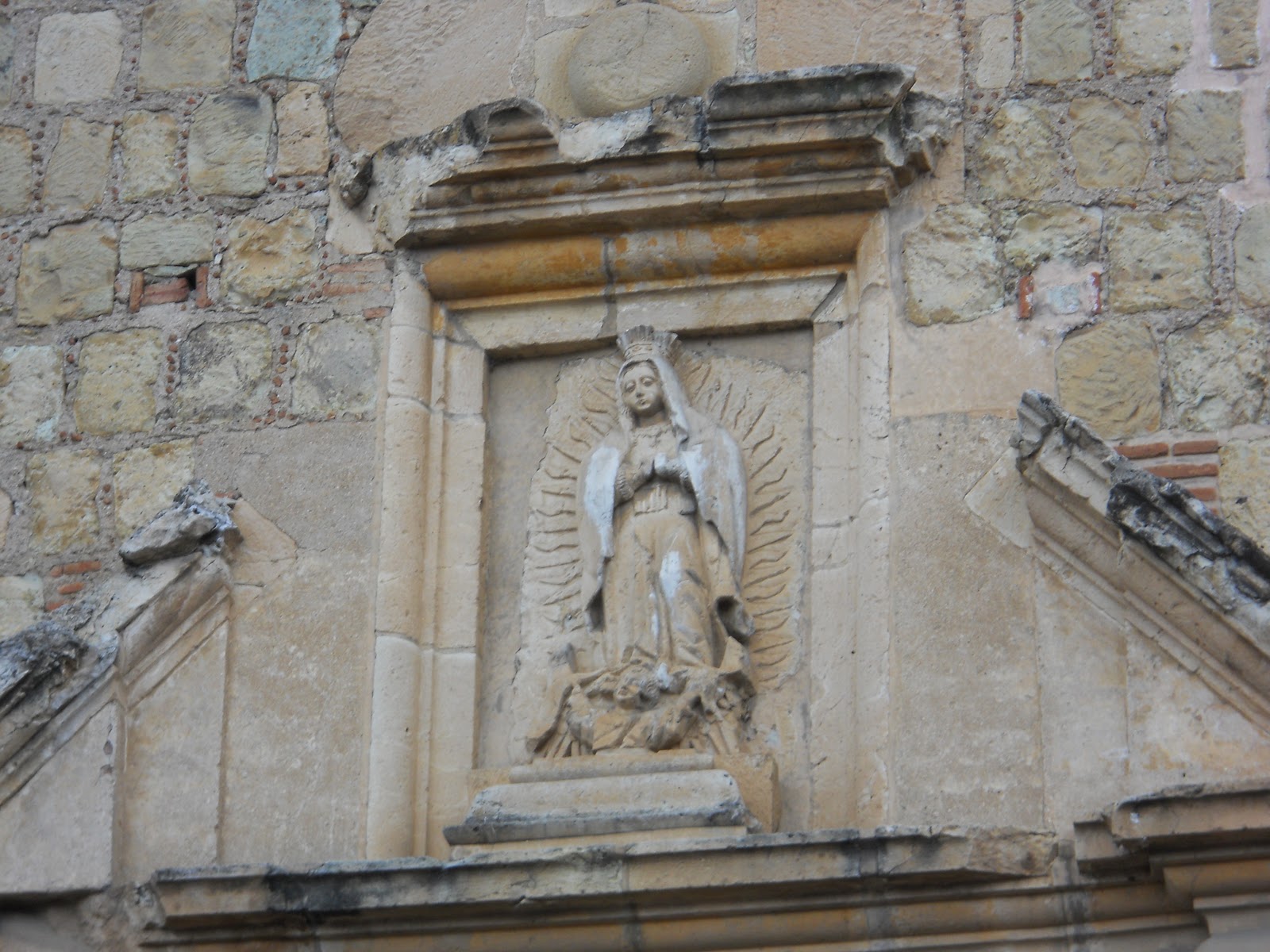
  We opted for a short siesta--short because they're adding a third story to the hotel, hence much construction noise. Fireworks, traffic, and the occasional marching band outside. Seemed like it was time for a stroll. Oaxaca is a good place just to walk and look--the architecture has a lot of both Spanish and French influence, along with a lot of Catholocism. I am entranced by what I called "nichos" (not an exact use of the term which usually refers to artwork with little niches)--little niches in the walls with a saint or the vigin in them. 


 We wandered a store calls "Los Ninos de los Posadas" which is where you can find all things religious--vestments, holy water fonts, crowns, rosaries, statues of saints, priests, Jesus (both on the cross and as a baby) in riotous profusion. What we rather irreverently called "blue man Jesus group" (I guess that you dress him).


And in case you realized that you forgot to pick up a baby Jesus while you were in there, another store had a whole case of them.


By now it we were tired--grabbed a light dinner from a corn on the cob stand (they're everywhere)--they rub it with lime, salt and chili (yum).  The corn they grow is field corn.  Eric later told us a story about when he took some native potters to the states and they were invited to a barbecue.  They launched into the "familiar" food--corn on the cob and beans.  Then took a bite, made a face--"Don Eric--the corn is sweet!!"  Then went for the baked beans, and another shocked "Don Eric--the beans are sweet!!"  So we happily ate our starchy chilied corn, and off to bed.

Saturday, November 5, 2011

October

It started well, that month.  Nice and quiet and under control.  Not normal circumstances in my world . . .

Because Bob and I had planned for a long-awaited trip to Mexico for Day of the Dead, we gave up doing the haunted trail at the museum this year.  It was not a last-minute decision; I had told Jennifer (my boss lady) a year and a half ago that last year's Halloween Howl would be our last.  Love it much--but it takes months of planning, the entire month of October to build the trail, and then most of November to take it down and put it away.  A friend of the Museum's director volunteered to run the trail this year.  All was well.

Until the middle of October.  She had a lot of enthusiasm and still thought it would be wonderful--but hadn't actually gotten around to doing anything.  The loss of a haunted trail would seem like no big deal--but the Halloween Howl is a big fundraiser for the museum (we made about $30,000 in the two nights last year) and a huge part of that--the part that brings in the college kids and the teenagers and a lot of adults, and not just families--is the haunted trail.  The museum budget is tight enough without taking a big hit.

So . . . two weeks before the Howl I designed Trail Light (no elaborate scenes or special effects) and gave the big puppy dog eyes to Bob and asked for a day of building from him.  The stars smiled upon us, because Jennifer was able to hire a marvelous carpenter/man of all trades named Jason who really put his heart into the building.  And Brother Michael, who flew into town for our father's birthday got to spend two days of quality time with his sister--building the trail (he is a really good sport).  Then I let him take the weekend off (because, after all, it was Dad's birthday).

Sort of off--he's never been in a kayak, so on Saturday we took him to Wakulla River and put him in one (did I mention he's a good sport?)  It's one thing to see Wild Florida from a riverboat tour; another to see it at eye level.  It was a beautiful day.  A bit chilly so we didn't see as many animals as usual, but one alligator cooperated and posed nicely.   He looked comfortable so Mike decided to admire him from a discrete distance and not disturb him.

Sunday was a bit more sedate--if you can call going to a museum gallery show called Cute and Creepy sedate (http://www.mofa.fsu.edu/).  There are some "interesting" pieces in that show (I admire them--wish I had the skill and imagination to put together stuff like this)
Then we went to take Dad his birthday gift (his birthday was Saturday but we couldn't fit the gift into the truck with the kayaks and the three of us)  We couldn't resist getting Dad a radio controlled flying fish.  Seriously--it's a mylar balloon with a movable tail and a weight on a track so it can go up and down.  Here's a video of one in action (we got the clownfish):  http://www.youtube.com/watch?v=vIJINiK9azc

Mike decided that the only way he was going to get some rest was to go home, so he hopped on a plane Monday morning.  Bob and I--went to work.  I also worked Tuesday morning--then back to the Museum to work with Jason to finish the trail.  Bob and Rob and Jeff joined us that night to tweak the lights.
Wednesday--errands.  Thursday--some made housecleaning and packing and off to Jacksonville (because it's a heckuva lot cheaper to fly out of Jacksonville than Tallahassee) to hop a plane ourselves for Mexico.  Because after such a nice quiet month--we were ready for that vacation!

Friday, September 30, 2011

FAZED

I was able to attend a FAZE (Florida Association of Zoological Educators) at the Jacksonville Zoo.  It's great to be able to meet talk with people with venues extending from Disney World to small town zoo/museums. We had three round-table discussion--how to offer premier/VIP programs (to bring in money), how to present to large audiences (to get the message/education out) and adult programs (how to get them to come in even if they're not bringing kids).  Brainstorming with others is always good.


And then the really fun stuff. Tim Lawrence, one of their volunteers with a background of creating sculptures and special effects (sculpting for the Shrek movies, among others) talked about making life casts of some of the museum animals. When they have to be anaesthesitized for procedures, he works with the vets to quickly take molds of faces, hands, feets, shells, whatever). The casts can then be used as study aids, props, or cast into metal. For instance, you get to see exactly how big a gorilla's hand can be. This process can also be used for functional items as well as art. One of the zoo's little wading birds had lost part of his leg in an accident. Tim took a mold of the remaining leg and was able to sculpt a little prosthetic leg for him (it works).  And, as a favor for coming to the conference, we each got a casting of a lion's teeth (how cool--you normally get a pencil or bookmark)

After dinner we went on a behind-the-scenes night tour (we were asked not to publish pictures).  Again--amazing.  Rhinos are much bigger when there is only a fence between you.  And giraffes are very tall indeed when you are standing right beside their stall.  It's funny how your brain refuses to acknowledge that an animal can be almost 20 feet tall--I kept checking be to sure he wasn't standing on a platform.

In the morning after breakfast we were able to hand-feed stingrays (they have very soft flexible lips that can create quite a vacuum to suck the food up.  The big thrill of the conference came after the morning round-table discussion: we were able to watch (up close!) the gorilla training.

Gorillas can be big--really big.  And strong.  And intelligent.  In order to keep them healthy, zookeepers do have to give regular checkups and sometimes medication.  Traditionally, the animal has to be darted, hauled inside (and they can weigh 500+ pounds) and anesthetized .  This can be pretty rough on any animal.  Instead of this, they work with the gorillas to get their cooperation.  We watched the keeper put the big male silverback through his daily routine.  He comes up to a (very sturdy) fence, and, upon request, will push his chest up to it (they've even given him ultrasounds this way), hold up his hands or feet, turn an ear to the wire, or open his mouth wide.  Now if a vet needs to give him a shot or check a sore spot on his foot, Qinto (the gorilla we watched) will simply put his shoulder or foot up to the fence.  Far less traumatic for both him and the vet than the old "knock him out" routine. 

Here's a couple more pictures.  The first one shows the conflict I have about zoos.  I love being able to see the animals, and learn about them--but no matter how well they're cared for, and how nice the habitat is, it's still captivity.   But the other one shows his editorial comment about the guests.

Friday, September 23, 2011

Indigo

Just in from caring for the critters.  Things are mildly out of hand--I released my two opossums, but got two more and six squirrels.  The squirrels were at the "finishing stage"--almost off milk, and about ready to prepare for release.  And they're a royal pain.  I love raising squirrels, but didn't do any tiny babies this year.  So this is getting the adolescents without the fun part.  They'll be going out in the release cage today. 

But that's not today's blog.  Today I'm talking about my indigo workshop that I gave last week at the museum.  Indigo is just a fun dye to work with--because the dyebath is green (or greenish-yellow) and when you pull the items out they react to the air to turn blue.  And no matter how many times I see it, it's still magic, and I like hearing the "oooooooo" as others see it for the first time.  I also like the expressions on their faces when I explain that historically in Europe stale urine was used to develop the color (we bypassed this step in favor of modern chemical assists)  And just to keep things interesting we did tie-dye on various samples, and finally they all got a silk scarf to dye and take home.


And here is today's eye candy.  While the historic collection that I'm trying to deal with is a right royal mess, I am enjoying the treasures that I find.  My big love is the late 1800s--they just got so carried away with piling on the decorations.  Here's a little capelet to just finish off an outfit.